- Most Republicans and Democrats believe there should be federal policies in place to make housing more affordable, according to a recent Redfin survey.
- For instance, 85% of Democrats say there should be first-time buyer tax breaks, and so do 77% of Republicans.
- These survey results align with broad bipartisan support behind the federal ROAD to Housing Act recently passed by Congress. Redfin Chief Economist Daryl Fairweather says the bill shows that government policies can help housing affordability without spending big.
Most Americans support government policies that would help make housing more affordable. Roughly four in five (79%) U.S. residents believe there should be tax breaks for first-time homebuyers, and 77% believe there should be policies that make homes more affordable, per a recent Redfin survey.
Three-quarters (76%) of U.S. residents say there should be caps on rent increases, 75% believe there should be initiatives for building homes for low-income families, and 74% think there should be programs for down payment assistance. Just over half (54%) say there should be policies that make it easy to build homes in their area–the lowest share among the policies we asked about, but still majority support.
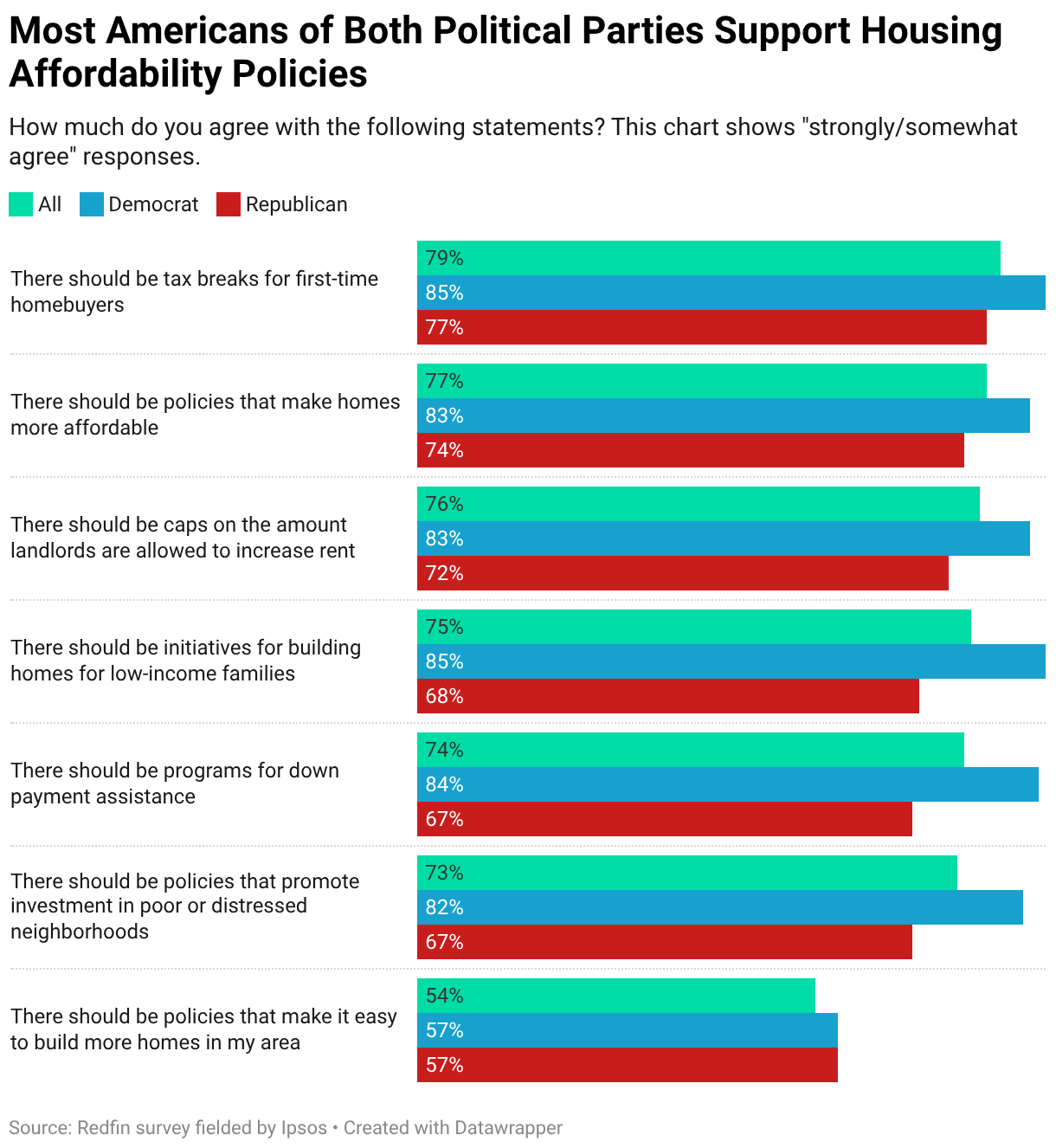
This is according to a Redfin survey conducted by Ipsos in May 2026, fielded to 4,000 U.S. residents. This report focuses on the following question: “How much do you agree with the following statements?” Respondents were provided with a list of statements about housing policies; the full list is in the chart above. Please see the end of this report for more on methodology.
Support For Housing Policies Is Bipartisan
Democrats are generally more likely than Republicans to support housing programs, but not by much. For instance, 83% of Democrats say there should be policies that make homes more affordable, as do 74% of Republicans. Eighty-five percent of Democrats say there should be first-time buyer tax breaks, as do 77% of Republicans.
These survey results align with the broad bipartisan support behind the federal ROAD to Housing Act that Congress signed on June 23 and is currently in political limbo as President Trump delays plans to sign it. The legislation is aimed at tackling the nationwide housing affordability crisis by increasing housing supply, streamlining building processes and expanding access to affordable homeownership opportunities.
“For over a decade, the prevailing view was that housing was a local issue best left to city councils and mayors–but housing affordability has become a national crisis,” said Daryl Fairweather, Redfin’s chief economist. “By passing this bill out of the Senate Banking Committee 24-0, Republicans and Democrats alike showed that affordability is a priority. The great accomplishment of the bill itself is that it uses solutions like zoning reform and improved permitting to prove that government policies can make people better off without spending big.”
One policy in the ROAD to Housing Act is an effort to expand manufactured housing–a lower-cost alternative to traditional homes–by streamlining federal regulations. Bipartisan backers argue that increasing the supply of lower-cost houses can improve affordability for both homebuyers and renters. That ties in with the survey results in this report, which show that 85% of Democrats and 68% of Republicans believe there should be initiatives for building homes for low-income families. Additionally, nearly three in five (57%) respondents from each party say there should be policies to make it easier to build homes in their area.
Methodology
The survey results in this report are from a Redfin survey conducted by Ipsos in May 2026. It was fielded to a nationally representative sample of 4,000 adults 18+ who are U.S. residents, including 1,338 Democrats and 1,167 Republicans. The results for this combined group of survey respondents have a credibility interval of +/-1.9 percentage points. The credibility interval is +/- 3.3 percentage points for Democrats and +/- 3.5 percentage points for Republicans.
This report focuses on the following question: How much do you agree with the following statements? Respondents were provided with a list of statements about housing policies; the full list is in the chart above. They could choose “strongly agree,” “somewhat agree,” “neither agree nor disagree,” “somewhat oppose” or “strongly oppose.” We combined “strongly agree” and “somewhat agree” responses for this report.
We included responses broken out by political party: Democrat or Republican. The results for respondents who identified as “Independent” are not included in this report.