-
- Home prices rose 0.3% month over month on a seasonally adjusted basis.
- Prices rose 2.5% on a year-over-year basis–the fastest growth rate in six months.
- On a local level, prices rose in 29 major metros month over month, with the biggest increases in Cleveland, Providence and New York.
- This is based on the Redfin Home Price Index (RHPI), a repeat-sales measure of seasonally adjusted home-price changes that is reported about a month earlier than the Case-Shiller Index.
U.S. home prices increased 0.3% month over month in May on a seasonally adjusted basis, the fastest growth rate since January.
Prices rose 2.5% from a year earlier, the fastest year-over-year growth in six months.
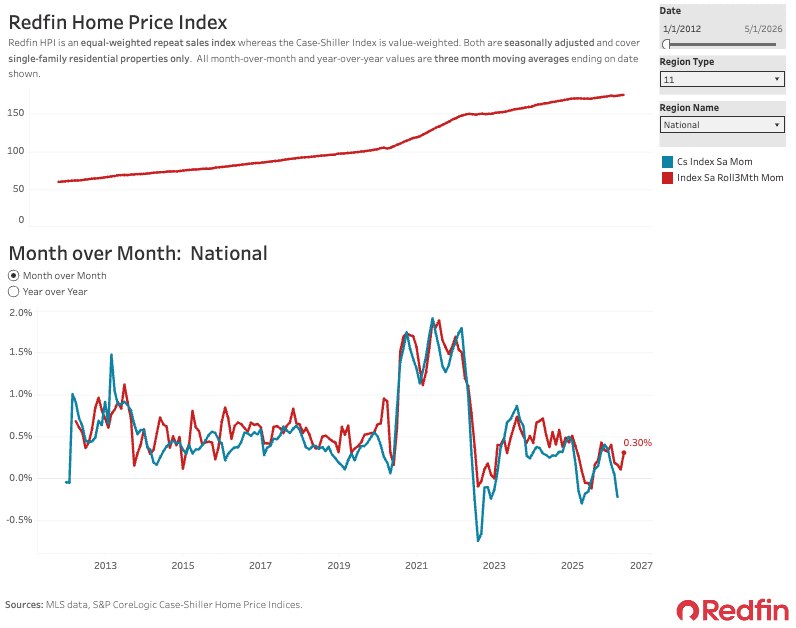
This is according to the Redfin Home Price Index (RHPI), which uses the repeat-sales pricing method to calculate seasonally adjusted changes in single-family home prices. The RHPI measures how sale prices of homes have changed since their previous sale—similar to the S&P Cotality Case-Shiller Home Price Indices—but is reported about a month earlier. May data covers the three months ending May 31, 2026. Read the full RHPI methodology here.
Home-price growth picked up steam in May because that month’s prices reflected deals that went under contract in April, when homebuying demand strengthened as mortgage rates declined. Closed U.S. home sales hit their highest level since 2022 in May, and while inventory is also ticking up, there still aren’t enough desirable, affordable homes on the market.
Note that pending sales–a more current gauge of the market–have since flattened, largely because mortgage rates rose throughout May. But because new listings are also flattening, home prices may continue to rise at their current pace.
“Buyers got a boost from lower mortgage rates in the spring, and that momentum is showing up in prices,” said Sheharyar Bokhari, a senior economist at Redfin. “And even though there are many more home sellers than buyers in the market, the most desirable homes are still attracting multiple offers, driving up prices. Buyers who are waiting for prices to fall may not get much relief; instead, they may consider expanding their search area or negotiating for concessions–like mortgage-rate buydowns or closing-cost credits–from sellers.”
Home Prices Are Rising in Most Major Metros, Led by Ohio and the Northeast
Home prices rose in 29 major U.S. metros month over month on a seasonally adjusted basis in May. Redfin analyzed the 50 most populous U.S. metro areas and included the 49 with sufficient data.
The biggest uptick was in Cleveland, where home prices rose 2.5% month over month. It’s followed by Providence, RI (1.8%), New York (1.8%), Miami (1.5%) and Columbus, OH (1.3%). Providence is one of just seven seller’s markets in the U.S., and Cleveland and New York are balanced markets; buyers are more likely to bid up prices in those places than in the 35 buyer’s markets.
Prices declined in 19 of the metros in this analysis, with the biggest drop in Riverside, CA (-1.9%). It’s followed by San Jose, CA (-1.7%), San Francisco (-1.3%), Phoenix (-1%) and Denver (-0.7%).
While San Francisco prices fell month over month, they’re soaring on a year-over-year basis, largely because of the AI boom. San Francisco home prices rose 11.7% year over year, the biggest increase in the U.S. It’s followed by Chicago (10.7%), Newark, NJ (10.2%), Milwaukee (9.8%) and Nassau County, NY (9.8%).
The biggest year-over-year declines were in Austin, TX (-3.8%), San Antonio (-2.4%), Dallas (-2.2%), Jacksonville, FL (-2.1%) and Orlando, FL (-2%).
| Metro-Level Summary: Redfin Home Price Index, May 2026 | ||
| U.S. metro area | Month-over-month change, seasonally adjusted | Year-over-year change |
| Anaheim, CA | 0.3% | 3.9% |
| Atlanta, GA | -0.1% | -1.3% |
| Austin, TX | 0.9% | -3.8% |
| Baltimore, MD | -0.1% | 3.6% |
| Boston, MA | -0.1% | 2.2% |
| Charlotte, NC | -0.6% | 4.4% |
| Chicago, IL | 0.5% | 10.7% |
| Cincinnati, OH | 1.0% | 5.1% |
| Cleveland, OH | 2.5% | 9.2% |
| Columbus, OH | 1.3% | 3.7% |
| Dallas, TX | 0.3% | -2.2% |
| Denver, CO | -0.7% | 1.1% |
| Detroit, MI | 0.9% | 6.9% |
| Fort Worth, TX | 0.3% | -0.7% |
| Houston, TX | -0.3% | -1.5% |
| Indianapolis, IN | 0.4% | 1.0% |
| Jacksonville, FL | 0.6% | -2.1% |
| Kansas City, MO | 0.3% | 2.3% |
| Las Vegas, NV | -0.2% | 0.4% |
| Los Angeles, CA | 0.5% | 2.4% |
| Miami, FL | 1.5% | 4.3% |
| Milwaukee, WI | 1.0% | 9.8% |
| Minneapolis, MN | 0.7% | 3.5% |
| Montgomery County, PA | 0.4% | 9.8% |
| Nashville, TN | 0.0% | 0.4% |
| Nassau County, NY | 1.2% | 9.8% |
| New Brunswick, NJ | 0.7% | 4.4% |
| New York, NY | 1.8% | 7.7% |
| Newark, NJ | 1.2% | 10.2% |
| Oakland, CA | -0.6% | -0.8% |
| Orlando, FL | -0.1% | -2.0% |
| Philadelphia, PA | 0.6% | 8.1% |
| Phoenix, AZ | -1.0% | -1.7% |
| Pittsburgh, PA | -0.5% | 4.5% |
| Portland, OR | -0.6% | -0.1% |
| Providence, RI | 1.8% | 4.9% |
| Riverside, CA | -1.9% | 0.1% |
| Sacramento, CA | 0.2% | 0.1% |
| San Antonio, TX | 0.0% | -2.4% |
| San Diego, CA | 0.2% | 0.9% |
| San Francisco, CA | -1.3% | 11.7% |
| San Jose, CA | -1.7% | 1.5% |
| Seattle, WA | -0.7% | -0.1% |
| St. Louis, MO | -0.5% | 3.5% |
| Tampa, FL | 0.2% | 3.0% |
| Virginia Beach, VA | -0.1% | 4.6% |
| Warren, MI | -0.3% | 3.8% |
| Washington, DC | 0.5% | 3.0% |
| West Palm Beach, FL | 0.4% | 4.5% |