Would-be home sellers are stepping back as high rates and economic jitters keep buyers on the sidelines.
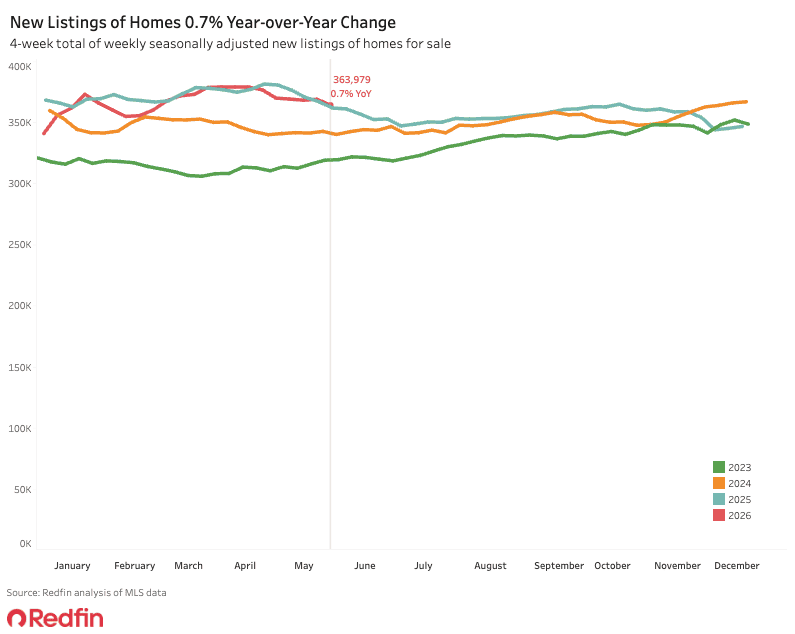
New listings of U.S. homes for sale are down 1.3% week over week, one of the biggest declines of the year.
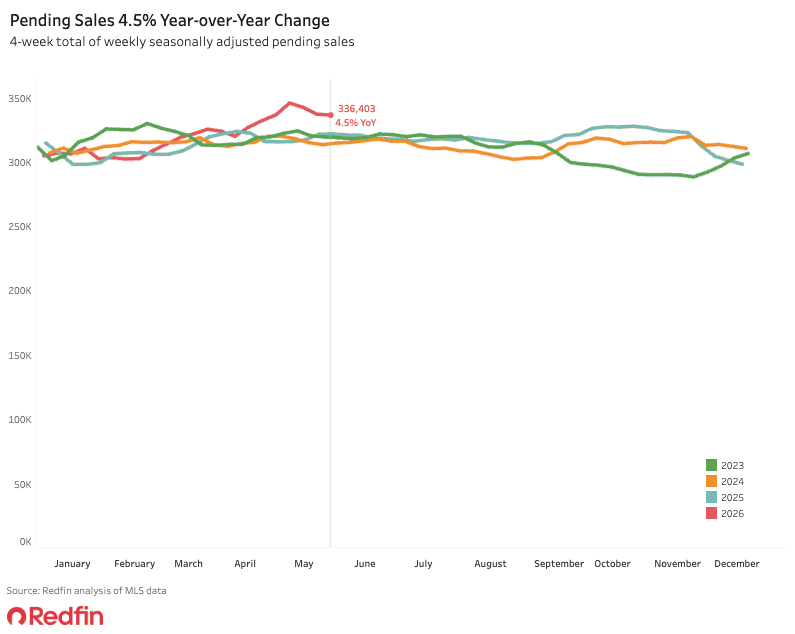
Prospective home sellers are backing off because homebuying demand has slowed down. Pending home sales ticked down 0.2% week over week during the week ending May 31–a small decline, but the third in a row. Mortgage-purchase applications fell to their lowest level in six weeks.
There are a couple reasons house hunters–and, by extension, would-be sellers–are stepping back:
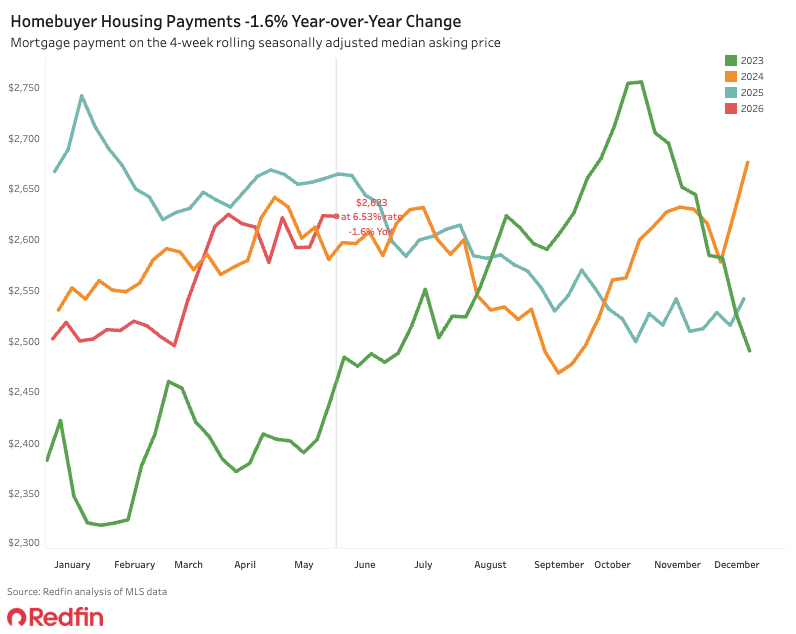
- Housing costs are high, and getting higher. The weekly average mortgage rate rose to 6.53%, its highest level since August. Despite rising rates and slowing demand, sale prices just keep rising: The typical sale price is up 2.3% year over year. Those two factors have pushed the typical monthly housing payment to $2,623, near its highest level in 11 months.
- The economy feels shaky. Consumer confidence dropped to an all-time low last week, due partly to rising food and gas prices. The ongoing Iran war and inflation fears are exacerbating financial jitters. Many Americans aren’t able to–or don’t want to–buy a home when the cost of everything else is rising.
“While this isn’t a market where sellers can count on bidding wars, there are always some people out there who need to move,” said Chen Zhao, Redfin’s head of economics research. “The market has been tilted in buyer’s favor for many months, but their advantage started to shrink last month. With new supply declining now, people who are serious about selling their home may want to jump in while there’s at least slightly less competition from other sellers.”
For Redfin economists’ takes on the housing market, please visit Redfin’s “From Our Economists” page.
Leading indicators
| Indicators of homebuying demand and activity | ||||
| Value (if applicable) | Recent change | Year-over-year change | Source | |
| Daily average 30-year fixed mortgage rate | 6.61% (June 3) | Down from 6.75% two weeks earlier | Down from 6.96% | Mortgage News Daily |
| Weekly average 30-year fixed mortgage rate | 6.53% (week ending May 28) | Highest level since August | Down from 6.89% | Freddie Mac |
| Mortgage-purchase applications (seasonally adjusted) | Down 3% from a week earlier (as of week ending May 29) | Up 7% | Mortgage Bankers Association | |
| Google searches of “homes for sale” | Highest level in nearly 3 years (as of May 31) | Up more than 25% | Google Trends | |
| Touring activity | Up 20% from the start of the year (as of May 31) | At this time last year, it was up 30% from the start of 2025 | ShowingTime | |
Key housing-market data
| U.S. highlights: Four weeks ending May 31, 2026
Redfin’s national metrics include data from 900+ U.S. metro areas and are based on homes listed and/or sold during the period. Weekly housing-market data goes back through 2021. Subject to revision. |
|||
| Four weeks ending May 31, 2026 | Year-over-year change | Notes | |
| Median sale price | $398,854 | 2.3% | |
| Median asking price (seasonally adjusted) | $401,644 | 1.3% | |
| Median monthly mortgage payment (seasonally adjusted) | $2,623 at a 6.53% mortgage rate | -1.6% | Near highest level in 11 months |
| Pending sales (seasonally adjusted) | 336,403 | 4.5% | |
| New listings (seasonally adjusted) | 363,979 | 0.7% | |
| Active listings (seasonally adjusted) | 1,488,246 | 0.6% | |
| Months of supply | 3.5 | -0.2 pts. | 4 to 5 months of supply is considered balanced, with a lower number indicating seller’s market conditions |
| Share of homes off market in two weeks | 38.5% | Essentially unchanged | |
| Median days on market | 39 | +1 day | |
| Share of home listings with price drops | 19% | Down from 20% | |
| Share of homes sold above list price | 28% | Down from 29% | |
| Average sale-to-list price ratio | 99% | Down slightly | |
|
Metro-level highlights: Four weeks ending May 31, 2026 Redfin’s metro-level data includes the 50 most populous U.S. metros. Select metros may be excluded from time to time to ensure data accuracy. |
|||
|---|---|---|---|
| Metros with biggest year-over-year increases | Metros with biggest year-over-year decreases |
Notes |
|
|
Median sale price |
San Francisco (11.8%) Pittsburgh (8.8%) St. Louis (6.9%) Jacksonville, FL (6.5%) Newark, NJ (6.1%) |
San Jose, CA (-4.7%)
Orlando, FL (-2.4%) Fort Worth, TX (-1%) Seattle (-0.8%) San Antonio (-0.3%) |
Declined in 8 metros |
| Pending sales | West Palm Beach, FL (31.7%)
San Francisco (19.4%) Minneapolis (13.6%) Milwaukee (13.6%) Austin, TX (12.1%) |
Houston (-12.1%)
Seattle (-9.8%) Denver (-5.2%) Atlanta (-3.9%) Tampa, FL (-3.2%) |
Declined in 8 metros |
| New listings | Boston (13.5%)
Cincinnati (11.8%) Minneapolis (9.7%) Philadelphia (9.6%) New Brunswick, NJ (9%) |
St. Louis (-15.8%)
Dallas (-9.7%) Riverside, CA (-9.1%) Denver (-8.9%) Tampa, FL (-8.7%) |
|
Refer to our metrics definition page for explanations of all the metrics used in this report.